

2026 Porsche Cayenne Electric: The Ultimate High-Performance Luxury EV SUV

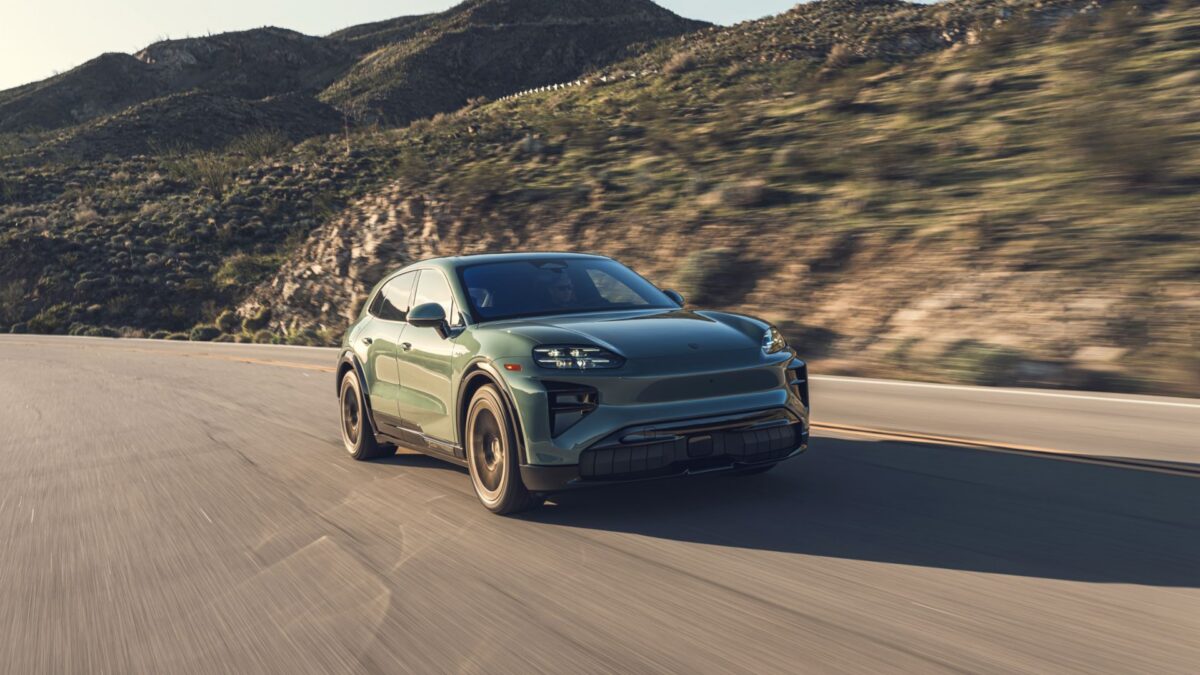
For over two decades, the Porsche Cayenne has consistently delivered on an ambitious promise: transforming a heavy, two-ton family SUV into a vehicle that handles like a 911. Millions of sales later, Stuttgart’s flagship SUV has funded racing programs and set the benchmark for performance utility vehicles. Now, Porsche engineers have taken a radical leap forward by swapping the traditional internal combustion powertrain for a massive battery pack.

The 2026 Porsche Cayenne Electric enters a highly competitive luxury market to answer a critical question for enthusiasts and daily commuters alike: is this all-electric SUV still a proper Porsche, or has it simply become a very fast, ultra-expensive gadget?
Sleek Design and Dynamic Aerodynamics
Visually, the Cayenne Electric maintains classic Porsche proportions while adopting a smoother, slightly elongated silhouette compared to its gasoline-powered counterpart. It rides on standard 20-inch aero wheels, with optional 21-inch and 22-inch designs available for a more aggressive stance. Sharp matrix-LED headlights illuminate the front fascia, while a modern light strip featuring illuminated Porsche lettering defines the rear end.
On the flagship Turbo model, functional aesthetics meet active engineering. At speeds above 65 km/h, motorized aero blades automatically deploy from the rear section to actively reduce drag. This transformer-like feature not only boosts driving range and high-speed stability, but it also brings a captivating sense of design theater to the luxury EV segment.
A Revolutionary Screen-Driven Interior and the “Ferry Pad”
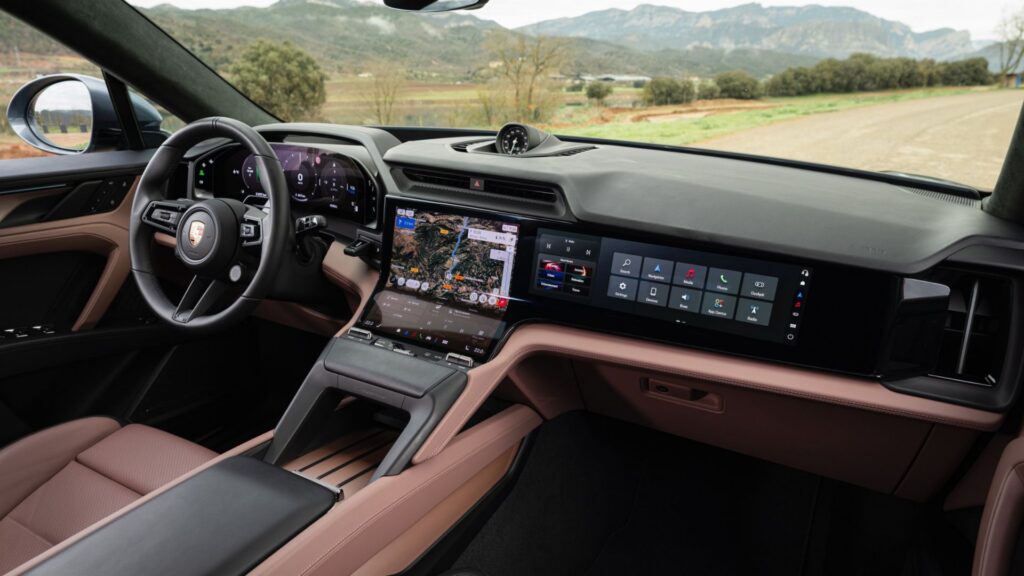
Stepping inside the cabin reveals a tech-forward cockpit dominated by premium display surfaces. The central highlight is a 12.25-inch curved OLED infotainment touchscreen that flows smoothly into the center console, boasting deep contrast levels and crisp resolution.
Recognizing the common frustration of trying to tap floating touchscreens on bumpy roads, Porsche introduced a clever ergonomic leather ledge situated directly below the main display. Named the “Ferry Pad”, an homage to Ferry Porsche, this resting spot allows drivers to anchor their palm, ensuring natural, steady finger placement along the lower screen controls.
The software platform is fully widget-based and customizable to individual driver preferences. Navigation maps can occupy the top section of the screen, while essential shortcuts, such as air suspension height adjustments, garage door openers, or controls for the optional electromagnetic panoramic glass roof, remain pinned along the lower curved boundary.
Drivers are also greeted by a hoodless 14.25-inch curved digital instrument cluster, derived from the Taycan, which handles vital electric powertrain data and full-screen telemetry. Front passengers aren’t left out either, as an optional 14.9-inch display allows them to stream media and watch content on the move.
Practicality, Frunk Storage, and Cabin Space
Because the Cayenne Electric is engineered on a bespoke, dedicated electric vehicle architecture, it eliminates the central transmission tunnel entirely. This flat-floor design translates to noticeable cabin gains, offering rear passengers significantly more legroom and foot space.
Practicality remains paramount for a midsize luxury SUV. Behind the second-row seats, the Cayenne Electric provides over 780 liters of standard cargo capacity. Folding down the 40/20/40 split rear backrests expands total load volume to over 1,500 liters. Additionally, replacing the internal combustion engine opens up a front trunk (“frunk”) perfect for stowing charging cables, mobile gear, or smaller travel bags.
Adaptive Air Suspension and Physics-Defying Active Ride
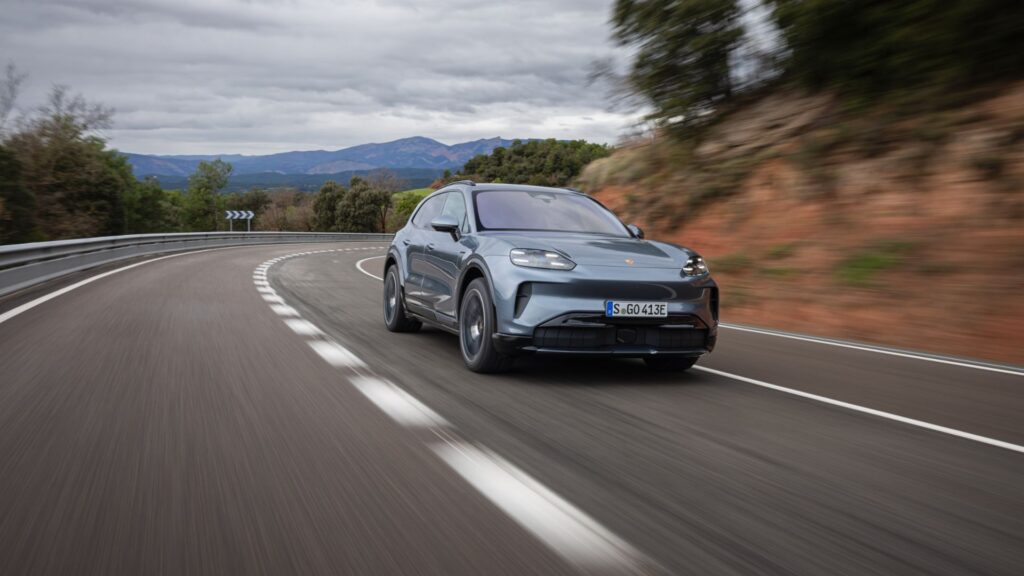
Managing the mass of an electric vehicle is one of the toughest challenges in automotive engineering, and the base Cayenne Electric tips the scales at over 2,500 kilograms. To maintain sharp handling and serene ride quality, Porsche equips the SUV with standard adaptive air suspension. Potholes and rough pavement are smoothed out effortlessly, giving the vehicle a hovercraft-like composure over uneven tarmac.
Buyers stepping up to the S or Turbo trim levels can select the advanced Porsche Active Ride system. This setup uses hydraulic pumps attached to individual dampers to actively counteract body motion. By rapidly adjusting fluid pressure at each wheel, the system keeps the SUV completely flat under aggressive cornering and heavy braking, offering a smooth, almost weightless driving experience.
Double-glazed acoustic glass paired with extensive sound insulation keeps cabin noise exceptionally low. However, for drivers missing the soundtrack of a traditional powertrain, Porsche developed an optional Electric Sport Sound system. Engineers recorded the authentic exhaust note of a twin-turbocharged V8 engine and digitally mapped it to the electric motor’s RPM, even mimicking brief torque interruptions to simulate gear shifts. While purists may prefer to turn this feature off via the touchscreen, it adds a familiar, emotive layer to high-speed driving.
Unmatched Acceleration and Dynamic Handling Specs
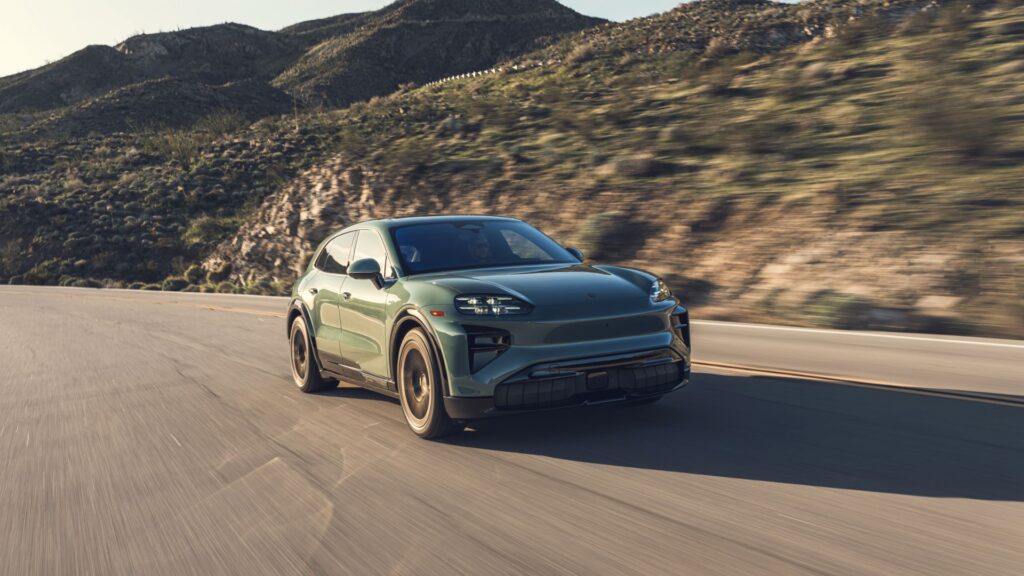
Straight-line performance in the Cayenne Electric spans from quick to mind-bending across its three core trim variants:
- Cayenne Electric (Base): Generates up to 435 peak horsepower and 616 lb-ft of torque, accelerating from 0 to 100 km/h in a swift 4.8 seconds.
- Cayenne Electric S: Increases performance output to 657 peak horsepower and 797 lb-ft of torque.
- Cayenne Electric Turbo: Delivers a staggering 1,139 peak horsepower and 1,106 lb-ft of torque, blasting from 0 to 100 km/h in just 2.5 seconds—putting supercar acceleration into a practical family vehicle.
The real engineering feat lies in how the SUV corners. Bolted directly into the chassis floor, the massive 113 kWh battery pack lowers the overall center of gravity while acting as a structural member to maximize frame rigidity. Coupled with dynamic motor torque vectoring, optional five-degree rear-axle steering, and Active Ride technology, the Cayenne Electric pivots around tight turns with incredible agility.
Range, 800-Volt Charging, and Canadian Pricing
Range anxiety is minimized thanks to the standard 113 kWh battery pack. While official Canadian EPA/NRCan estimates will be finalized closer to launch, European WLTP testing rates the standard model at up to 642 km, which translates to an estimated real-world Canadian range of roughly 530 km depending on driving conditions.
Charging times are equally impressive thanks to the advanced 800-volt architecture. The Cayenne Electric supports peak DC fast-charging rates up to 390 kW, enabling a 10% to 80% charge in just 16 minutes at a compatible high-speed station. Home charging is equally efficient; opting for the 19.6 kW AC on-board charger completes a 0% to 100% full charge in approximately 6.5 hours. Porsche also prepared the vehicle for future wireless pad charging equipment.

Canadian Base MSRP Pricing:
- Cayenne Electric Base: Starts at $131,300
- Cayenne Electric S: Starts at $142,600
- Cayenne Electric Turbo: Starts at $178,300
As expected with Porsche, optional equipment allows extensive personalization. Upgrades such as Oak Green Metallic paint ($3,250), 22-inch wheels ($4,200), Rear-Axle Steering ($1,470), and the Burmester Surround Sound System ($7,980) offer buyers complete control over their vehicle’s final specification.
Final Verdict: A New Era for Porsche Performance
While electric propulsion alters the mechanical feedback traditionally associated with gas engines, the 2026 Porsche Cayenne Electric stands out as a triumph of modern engineering. It pairs extreme power and rapid charging tech with exceptional cornering dynamics, high-end luxury, and daily utility. More than just a great EV, it represents a remarkable luxury performance SUV tailored for the modern electric age.
If you’d like to learn more or test drive the Cayenne Electric, please get in touch with us at one of our Porsche Centre locations or online at www.OpenRoadAuto.com